What Are The Key Considerations When We Talk About Freestalls?
Size and design
The first thing to consider when we talk about freestalls is its design. The dimensions we give to the cubicles, as well as the dimensions of the separators between beds will determine the comfort of our animals.
We recommend you to visit the website from the University of Wisconsin-Madison where you can find many references regarding sizes, maintenance and materials for freestalls and other animal facilities.
As there is a lot of size variation among animals, the most important thing is to observe their behaviour and the position they take when lying down. If the space available in the cubicle is too long, some animals will defecate and urinate on the bed. But if the space is too short, we may find that the animals do not want to lie there or that they lie diagonally.

Bedding material
Sand offers the lowest bacterial count, and the cows have excellent comfort. Facilities must be adapted to this type of material otherwise we will have many problems regarding the collection and storage of manure. Other limitations may be availability or cost. Be careful when using recycled sand, it must contain less than 1,5% of organic matter and dry matter should be over 95%.
For veterinarians who work in milk quality, our preferred material is sand.
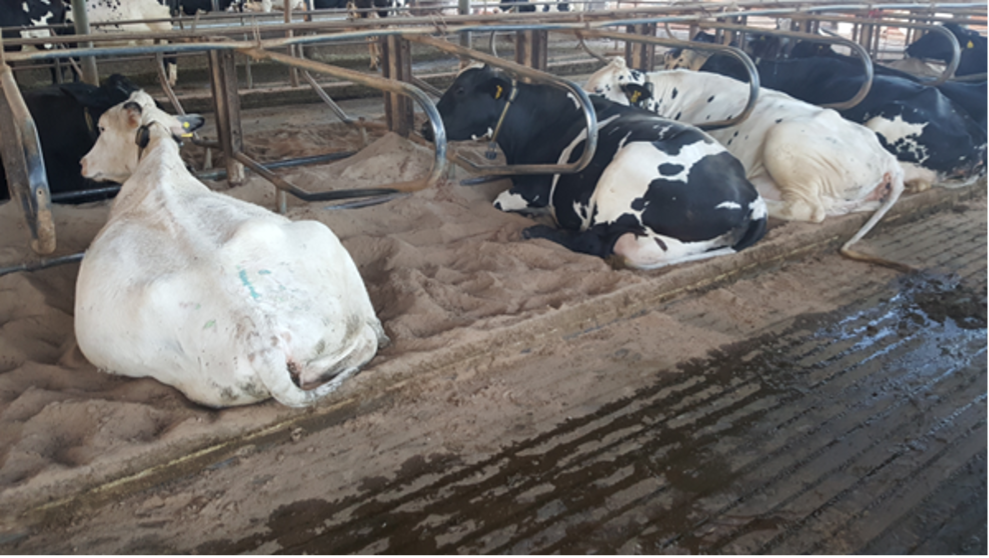
Another commonly used material is RMS (Recycled Manure Solids). This is an organic material from the manure solids separator, and we should always start with a material that has a minimum of 32-33% dry matter. It is a low-cost material that is widely available, but it can be very tricky in terms of udder health. When there are problems on a farm using RMS we usually find a high incidence of E. coli and Klebsiella mastitis.
If we think of RMS there can be different ways of working. There are farms that use RMS directly from the separator, without any treatment. Other farms will sanitize the manure (reaching pasteurization temperatures / eliminating pathogenic bacteria) before being use in the cubicles. We can find different systems to sanitize the RMS, ranging from the cheapest one that would be to leave the separated manure in long piles (1-1.5 m high) for about 10 days, to complex mechanized systems that provide sterilized material in 24h. There is no single system that works for everyone or on each farm, we have to adjust the system until we find the optimal point.
Straw has a very limited ability to absorb moisture unless it is very finely chopped, but in this case we run the risk to have a high bacterial growth. Our recommendation is to apply calcium carbonate or hydrated lime once a day to reduce moisture and increase the pH. When there are mastitis problems related to straw, we usually see a high presence of Streptococcus uberis .
Sawdust has a great ability to absorb moisture and is very comfortable, but we must monitor the dry matter level of the material. If the sawdust is fermenting when being stocked, we will have serious problems of clinical mastitis usually caused by of E. coli, Klebsiella and Serratia.
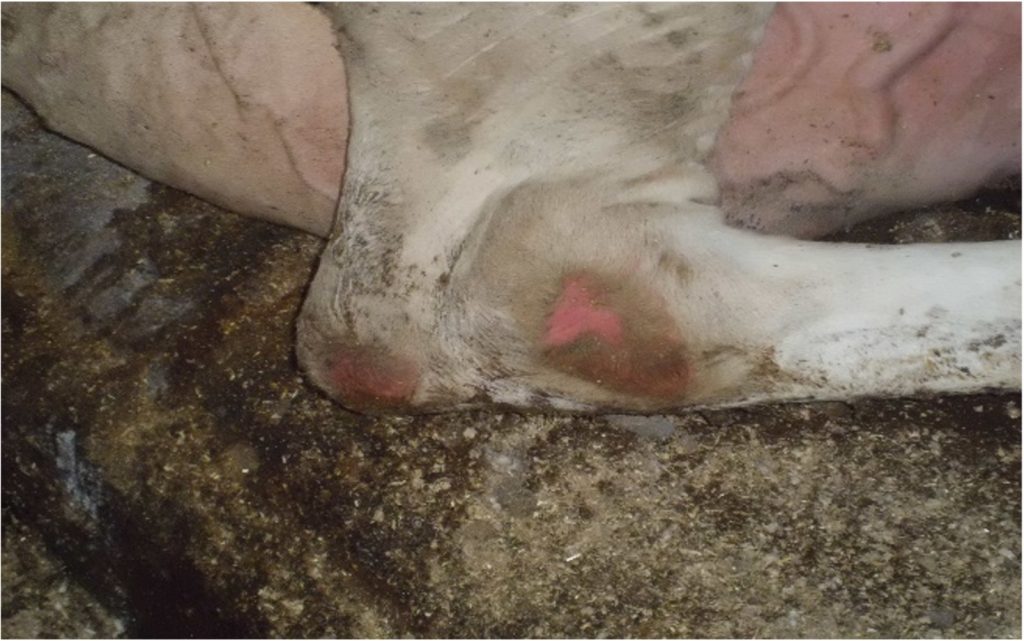
Finally, there are farms that choose to use mattresses in cubicles. There are many different types of mattresses on the market, but we can say that none of them achieve the levels of comfort that we achieve with other materials. It is common to observe joint injuries on farms with mattresses. Work needs to be done to keep them clean and dry material (lime or sawdust) needs to be added once or twice a day.
Conclusions
When talking about freestalls, the key considerations for ensuring maximum comfort and hygiene are the design and bedding material. Adequate dimensions are crucial, and we recommend referring to reliable guidelines to determine the optimal size. Bedding material is an essential factor, with the choice depending on availability, economic considerations, farm facilities, and animal health.
Article written by Oriol Franquesa, DVM, Qllet slp.